Startup content marketing: a blogging strategy for early-stage SaaS


Table of contents
1. Why content marketing hits differently for early-stage SaaS
2. Building a topic strategy that drives real organic traffic
3. Writing and publishing articles that rank, build trust, and convert readers
Most early-stage SaaS founders I talk to know they need content. They just have no idea where to start. There is no dedicated content team, the product roadmap is already eating every hour of the day, and publishing one blog post a week feels like an impossible lift. So content gets deprioritized, the blog sits empty, and organic traffic never materializes. The result is a growth channel that stays closed while paid ads drain the budget. A solid startup content marketing blogging strategy can change that dynamic completely. It will not happen overnight, but when you build it right from the start, the compounding effect is real. This guide walks through exactly how to do it: how to pick the right topics, how to structure content that ranks and converts, and how to keep publishing consistently even when your team is tiny.
Why content marketing hits differently for early-stage SaaS
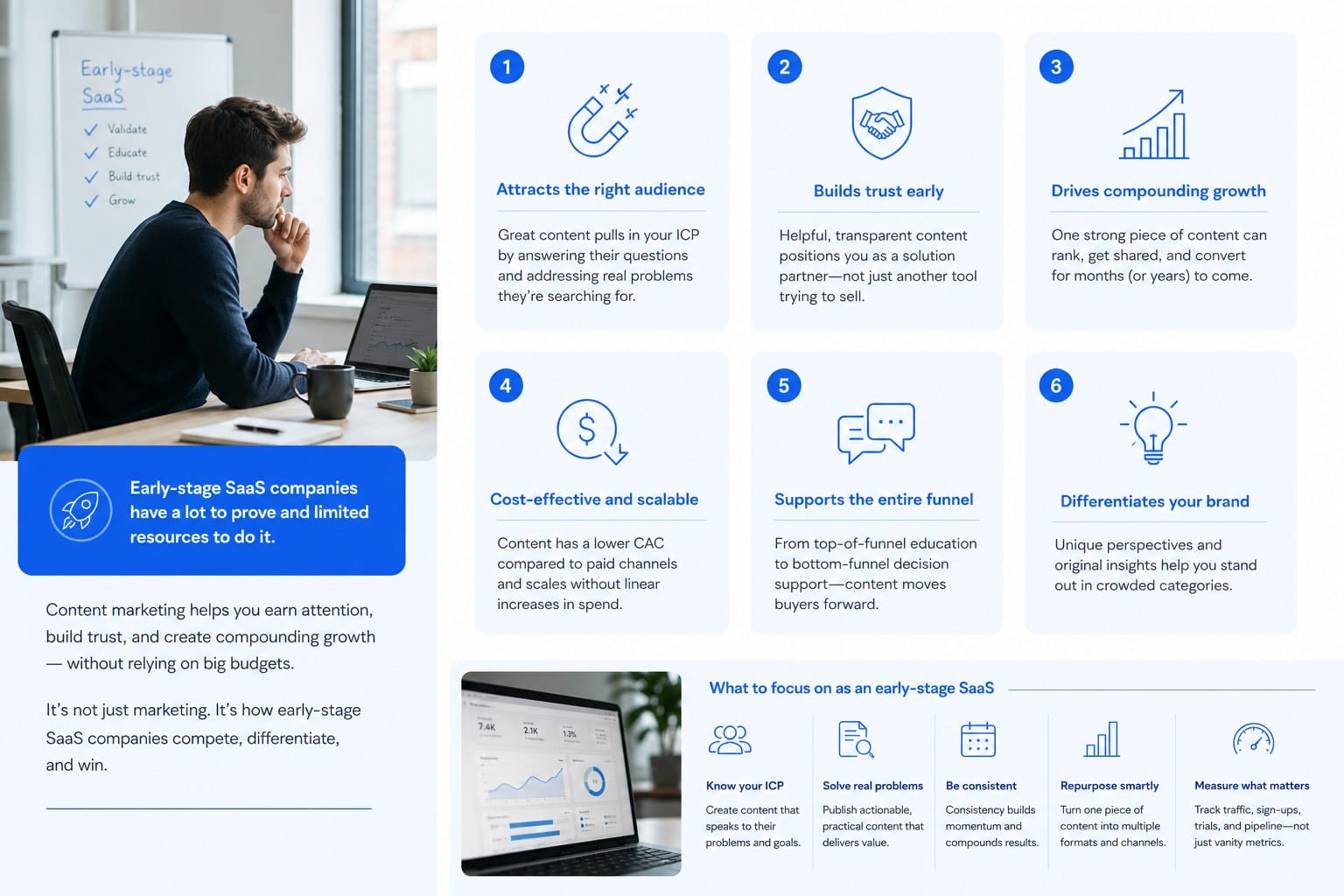
Paid acquisition is fast but fragile. The moment you stop spending, the traffic stops. Content works the other way. A well-written article published today can bring in qualified visitors six months from now, twelve months from now, and beyond. For a startup watching every dollar, that kind of leverage matters enormously.
The key word here is qualified. SaaS content marketing is not about volume for its own sake. It is about attracting people who have the exact problem your product solves. When someone searches for a specific question, finds your article, gets a genuinely useful answer, and then sees how your tool fits into the solution, the conversion path almost builds itself.
Here is a concrete example. Suppose you are building project management software for remote engineering teams. An article titled 'How to run async standups across time zones' targets a real, specific pain point that your ideal user is already searching for. It does not talk about your product directly. It helps the reader solve a real problem. But at the end, when you mention that your tool was built to address exactly this challenge, you have earned the right to make that pitch. The reader already trusts you because you gave them something useful before asking for anything.
This is the core logic of a good startup content marketing blogging strategy: meeting potential customers at the moment they are already looking for help, in the exact language they use to describe their own problems.
Early-stage SaaS companies have one structural advantage here that larger players often lack: founder knowledge. The people building the product usually understand the problem space deeply. They have lived the pain. They have talked to dozens of early customers. They know what questions come up repeatedly and what the existing solutions get wrong. That expertise, translated into clear and practical writing, beats generic content produced by a generalist agency every single time. You do not need a newsroom. You need a process for getting what you already know onto the page in a form that is useful to the people searching for it.
There is also a timing argument worth making explicitly. The earlier you start building content, the sooner your domain begins accumulating authority in the eyes of search engines. Domain authority grows slowly and non-linearly. Waiting until you have product-market fit to start blogging means waiting until you are already busy scaling to do the slow foundational work. Starting now, even imperfectly, is almost always better than waiting for the right moment that never quite arrives.
Let me say something directly about expectations because a lot of startup founders abandon content marketing too early. Most articles will not rank in their first month. Some will not rank in their first three months. Search engines index your content, evaluate it over time, and adjust rankings as they gather more data about how readers interact with it. The typical timeline from publishing to meaningful organic traffic is three to six months for a new domain. That is not a bug in the system. That is just how it works. The founders who understand this and keep publishing consistently are the ones who eventually see the payoff.
One more thing worth saying directly: content marketing does not work without consistency. A blog with three posts from eight months ago sends a clear signal to both readers and search algorithms. It signals that the company behind it either ran out of ideas or ran out of commitment. Activity matters. Freshness matters. An active blog that publishes regularly is treated differently by search engines than a static archive. The challenge for a small startup team is maintaining output without burning out, and that question of sustainability shapes everything about how you should build your content program from the start.
There is also a competitive moat being built here that is easy to underestimate. Every high-quality article you publish on a topic relevant to your buyers is one more piece of ground you occupy in your category. When a competitor eventually decides to invest in content, they are starting from zero. You are starting from a growing library of indexed, ranking content that is already compounding. The asymmetry of starting early is one of the most durable advantages available to an early-stage SaaS company, and it costs far less than a comparable paid acquisition budget.
The founders who treat their blog as a core product rather than a marketing afterthought are the ones who build traffic that survives economic downturns, algorithm updates, and competitive pressure. Paid channels can be turned off by a platform or priced out of reach. A content library you own cannot be taken away.
Building a topic strategy that drives real organic traffic
Random blogging does not work. Publishing whatever feels interesting or timely might fill the blog, but it will not build organic traffic in any meaningful way. You need a deliberate topic strategy, and building one is more straightforward than most people assume once you have a clear framework to follow.
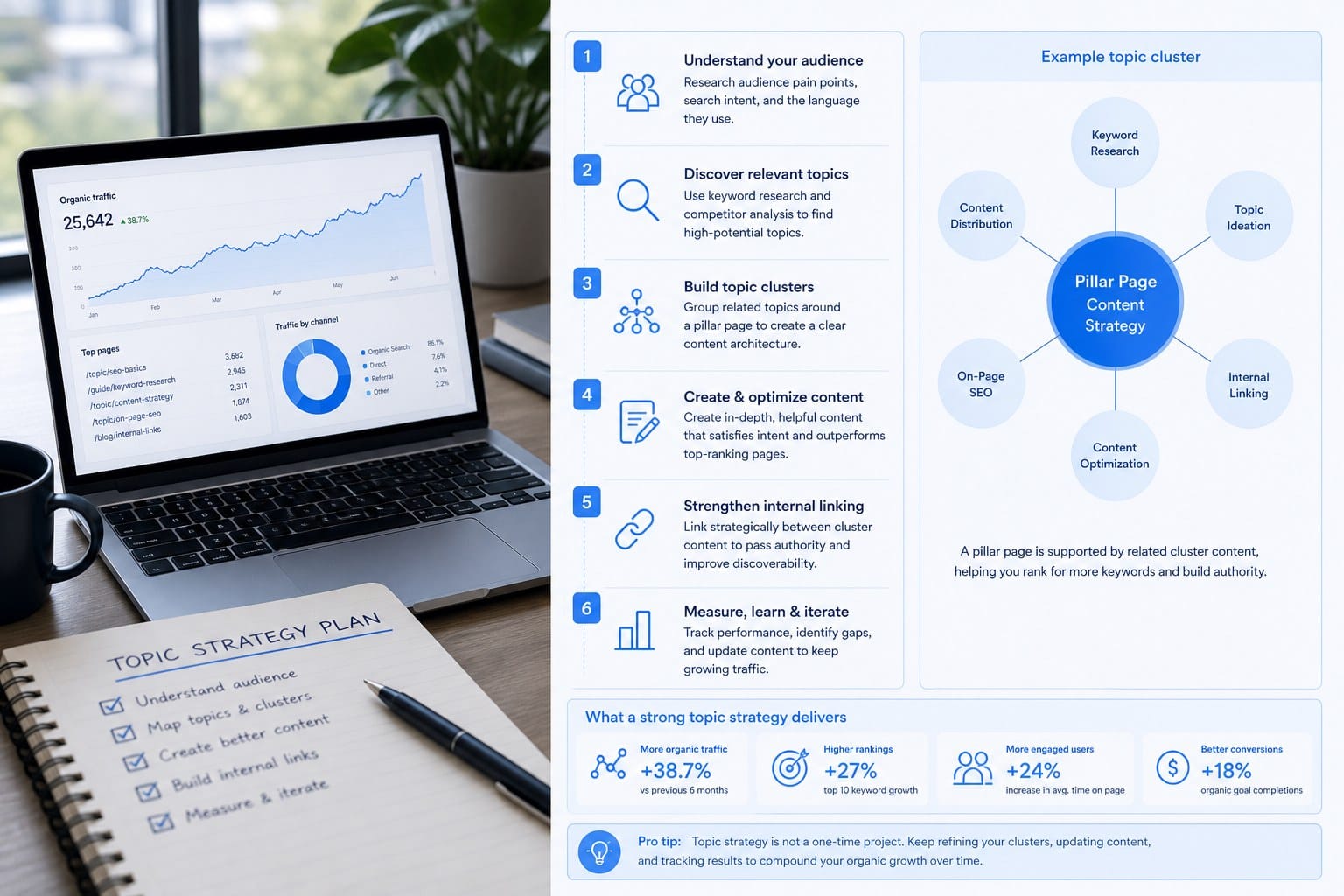
Start with your customer, not your product. Sit down and write out every question your ideal user was asking before they found your solution. What were they searching for at two in the morning when the problem was keeping them up? What problems were they trying to fix? What frustrations were they airing in forums, Slack communities, or Reddit threads? These questions are the raw material of a solid content strategy. They represent real demand that already exists. Your job is to meet it.
From there, organize those questions into clusters. A content cluster is a group of articles that all relate to a central theme, with one main pillar article covering the broad topic and several supporting posts going deeper on specific subtopics. This structure serves two purposes. It helps search engines understand what your site is about and builds topical authority around your category. It also helps readers find more of what they came for, which improves engagement metrics and keeps people on your site longer.
For example, if your central theme is remote team communication, your pillar article might be a comprehensive guide to remote communication practices and the tools that support them. Supporting articles might cover async video updates, building a documentation culture, running effective virtual meetings, onboarding remote employees without losing them in the first month, or managing feedback loops across time zones. Each supporting article links back to the pillar, and the pillar links out to the supporting pieces. The whole cluster reinforces itself in the eyes of both readers and search engines.
Keyword research is the other half of this equation. You need to know what words people actually type when they search for these topics, because the language your buyers use does not always match the internal language your team uses to describe the same problems. Tools like Google Search Console, which is free, will show you what queries are already bringing people to your site. Third-party tools can give you volume and difficulty estimates before you publish anything.
The goal at this stage is not to target the highest-volume keywords. High-volume terms are dominated by established sites with years of domain authority and dedicated SEO teams. Early-stage startups win by targeting long-tail keywords: more specific, lower competition search terms that still attract the right audience. A long-tail keyword like 'how to create a shared team inbox for customer support' gets far less monthly traffic than 'customer support software,' but it is also far more achievable to rank for, and the person searching it is much closer to actually buying something. Build your initial content around dozens of these specific terms rather than chasing the big general ones you have no realistic chance of ranking for in year one.
Search intent matters as much as volume, and misunderstanding it is one of the most common reasons otherwise good articles fail to rank. Every search query has an underlying intent. The person either wants to learn something, wants to compare options, or is ready to buy. Your content must match the intent of the keyword you are targeting. An article targeting an informational keyword should primarily educate without pushing a sale. An article targeting a comparison keyword should help the reader honestly weigh their options, including alternatives to your product where they genuinely fit better. An article targeting a transactional keyword can reasonably emphasize your product's strengths and include a direct call to action. Sending a reader who wants to learn something to a page that reads like a sales pitch is a fast way to earn a high bounce rate.
Once you have a list of target topics and keywords, turn them into a publishing schedule. A 30-day editorial calendar gives you structure without locking you into a rigid plan that cannot adapt to new information. Map out which articles you will publish each week, what keyword each one targets, what stage of the buyer journey it addresses, and what internal links it will include. This planning work is where many startup founders get stuck because it requires significant research time and familiarity with SEO mechanics that most technical founders have not had reason to develop.
For teams that want to move faster on this step, an AI-powered content strategy and editorial calendar planning workflow can compress weeks of research into hours, giving you a structured plan that accounts for keyword difficulty, topic clusters, and publishing cadence without requiring you to become an SEO expert in your spare time.
Competitive analysis is another piece that gets skipped too often. Look at what is already ranking for your target keywords. Read those articles carefully and critically. Ask yourself what they do well and where they fall short. Your goal is not to copy what is working but to identify the gaps you can fill. Maybe the existing articles are too high-level and your audience needs tactical depth. Maybe they were written three years ago and do not reflect how the tools or practices have evolved. Maybe they only address one side of a genuinely nuanced problem and gloss over the edge cases that real practitioners actually encounter. Those gaps are your opportunity to produce something that earns better rankings by being more useful.
Think carefully about distribution as you build your topic list. The best content strategy accounts not just for what you will publish but for how each piece will find its first readers before organic traffic kicks in. LinkedIn works well for SaaS audiences when you share a genuine perspective tied to the article rather than just a link. Niche communities like specific Slack groups or subreddits welcome useful content when it is shared genuinely rather than dropped as a promotional link. Email subscribers, even a small early list, give you a direct channel that does not depend on an algorithm. Building a small but engaged distribution infrastructure alongside your content program means your articles get their first signal of engagement from real readers, which helps search engines calibrate how to rank them.
Finally, be honest with yourself about the pace you can actually sustain. One high-quality article per week published consistently over six months will outperform four mediocre articles in a burst followed by two months of silence. Choose a volume you can genuinely maintain with the time and resources you have right now, and commit to it. Adjust upward as your process gets more efficient, but do not set a pace that collapses under the first busy product sprint.
Writing and publishing articles that rank, build trust, and convert readers
Having a topic strategy is one thing. Executing it well is another. The quality of the individual articles you produce determines whether all that strategic planning actually pays off in traffic and conversions.
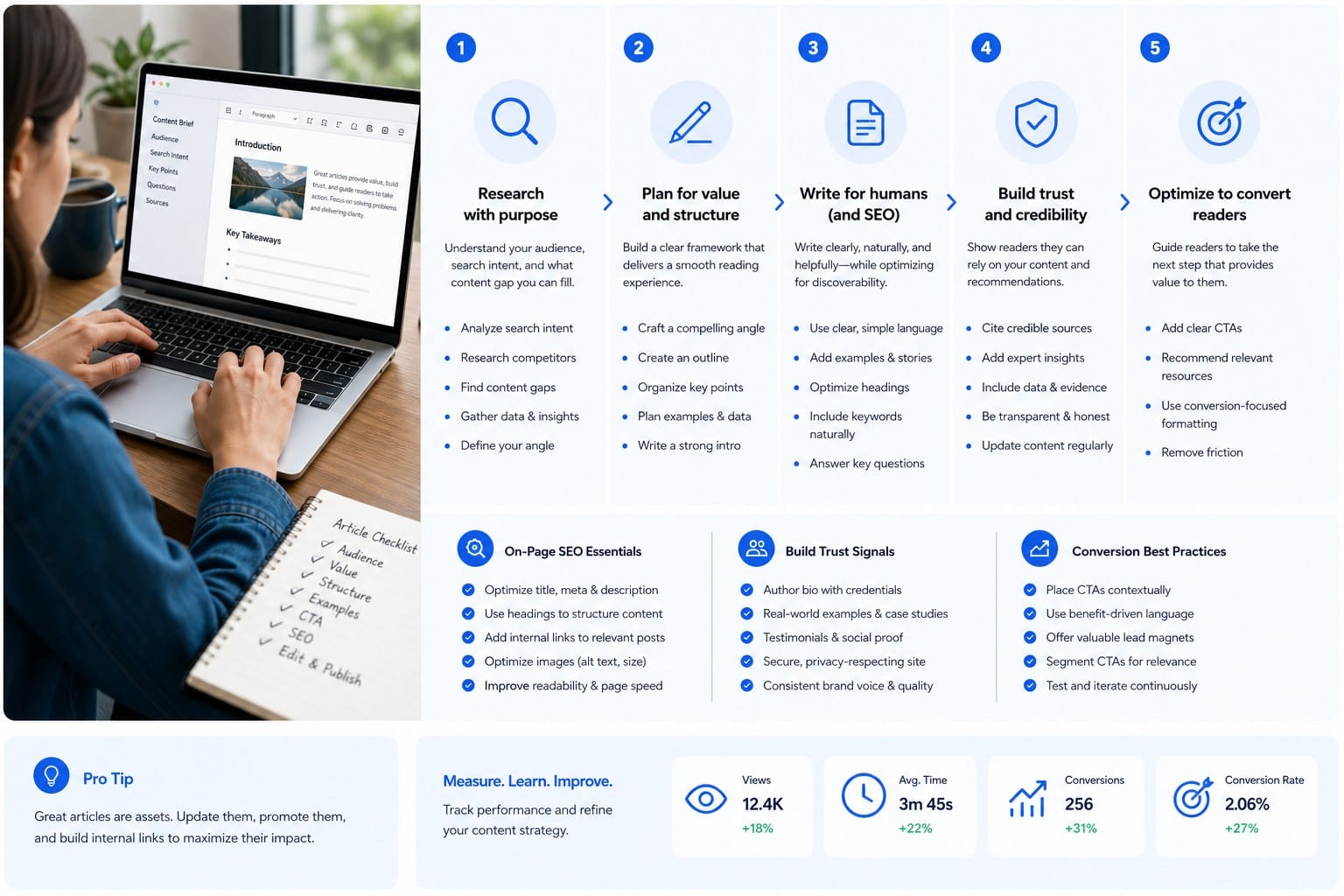
Start with structure because it is foundational to everything else. A blog article is not an essay. It does not build to a conclusion through flowing paragraphs designed to be read start to finish. Real readers skim. They jump to the subheading that looks most relevant, read a few paragraphs, scroll back up, and decide whether to commit to the whole piece. Short paragraphs, clear subheadings, and specific examples are not just stylistic preferences. They are functional choices that help real people absorb information in the way they actually read online content.
Every article you publish should have one clearly defined purpose. What does the reader know or be able to do after finishing this that they could not before? If you cannot answer that question in a single sentence before you start writing, the article is not focused enough. Tighten the scope. A narrow, deep article on a specific topic almost always outperforms a broad, shallow article trying to cover too much ground.
The opening of an article is where most readers decide whether to keep going. Do not spend the first three paragraphs explaining what you are about to tell them. Acknowledge the specific problem the reader showed up with, establish that you understand it from the inside rather than in the abstract, and give them a concrete reason to trust that what follows will be worth their time. Specificity is the fastest way to build that early credibility. Vague openings that could apply to any article on any topic are the fastest way to lose a reader who has already decided they are busy.
Throughout the body of the article, use real examples at every opportunity. Generic advice is easy to skim and easy to forget because it does not connect to anything concrete in the reader's experience. Specific scenarios, step-by-step walkthroughs, and concrete recommendations give the reader something they can actually apply. When you explain a concept, immediately follow it with an example that shows it in action in a real situation. This is especially important for SaaS content, where discussions of workflows, integrations, and processes can easily drift into abstraction that sounds plausible but does not help anyone do anything differently.
Internal linking is something most startup blogs dramatically underuse. Every article you publish should link to at least two or three other relevant articles on your site, and those links should feel like natural next steps rather than forced cross-promotions. This does two things: it helps search engines map the relationships between your content, which reinforces your topical authority, and it keeps readers on your site longer by giving them clear paths to more useful information. When you write an article about async standups, link to your article about remote onboarding. When you write about reducing customer churn, link to your article about proactive support practices. Build the internal web deliberately rather than leaving it to chance.
Depth is one of the most significant factors in whether an article ranks for competitive terms. Search engines have gotten very good at recognizing surface-level content that answers a question in 400 words when a thorough answer requires 1,500. Depth does not mean padding. It means genuinely covering the topic: addressing the common objections, the edge cases, the practical tradeoffs that real practitioners encounter when they try to implement the advice you are giving. Understanding what makes a blog article deeply researched is a genuine skill, and developing it early in your content program will save you from having to completely rewrite shallow articles later when you realize they are not ranking.
On-page SEO fundamentals are not optional and they are not complicated. Include your target keyword in the article title, in the first paragraph, in at least one subheading, and naturally throughout the body without forcing it into sentences where it does not fit. Write a meta description that accurately describes what the article covers and includes the keyword. Use descriptive alt text on any images that explains what the image shows. Make sure your pages load quickly on mobile, where a growing share of your readers will find you. None of this requires technical expertise, but skipping any of it means leaving ranking potential on the table for no good reason.
Calls to action deserve more careful thought than most startup blogs give them. Every article should have at least one, but the nature of the call to action must match where the reader is in their buying journey. An informational article attracting someone at the top of the funnel should offer a related resource, a newsletter signup, or an invitation to explore more content on the same topic. A comparison article attracting someone closer to a decision can reasonably point to a free trial or a product demo. Sending top-of-funnel readers directly to a pricing page is one of the most consistent conversion mistakes I see startup blogs make. The reader came to learn something. They did not ask to be sold to yet. Respecting that sequence is what earns the conversion later.
Publishing consistently is where most startup blogs eventually break down, not because the founders run out of ideas but because the production process itself is too slow and manual for the time they actually have. Writing a great article takes time. Researching the topic, drafting, editing, adding visuals, optimizing for SEO, formatting for the CMS, and publishing is a multi-hour process for each piece. When the same founder is also running sales calls, managing a product roadmap, and handling customer support escalations, content is always the thing that slips.
This is the specific problem that thoughtful automation can address. Not automation that produces generic, unresearched filler content, but automation that handles the research, drafting, formatting, and publishing workflow while preserving the quality standards that make content worth reading and worth ranking. If your blog runs on Ghost, integrating an AI content engine can dramatically reduce the manual lift involved in each article without sacrificing the depth that makes it useful. The setup process is more straightforward than most founders expect, as I walk through in this guide on how to integrate an AI blog tool with Ghost CMS.
The goal is to remove the friction between strategy and execution. When publishing a new article requires fifteen minutes of review and light editing rather than fifteen hours of production work, consistency becomes genuinely achievable for a two-person startup team. You can maintain the quality bar and the publishing cadence without sacrificing the product work that keeps the company alive.
Visuals are worth addressing directly because their impact is often underestimated. Blog articles without images or visual aids tend to perform worse on time-on-page metrics, and time on page matters both for SEO and for conversion. Visuals do not have to be elaborate or expensive. A simple diagram illustrating a workflow, a chart summarizing key data, a well-formatted screenshot of a relevant interface, or a comparison table that makes it easy to evaluate options all add genuine value without requiring a design team or a dedicated budget. What matters is that each visual is relevant and purposeful rather than decorative. Stock photos of people shaking hands in an office add nothing and readers know it.
Track what is working from day one. Set up Google Search Console and basic site analytics before you publish your first article. Which articles are generating impressions in search results? Which ones are attracting clicks? How long are people spending on each page and where are they going next? Which pieces are generating newsletter signups or trial starts? The data will tell you what to do more of and what to stop investing in. A startup content marketing blogging strategy is not a set-it-and-forget-it plan. It is a living system that you adjust based on what you observe over time.
Revisit your top-performing articles every quarter with fresh eyes. Can you expand them? Update them with new information that has emerged since you published? Add internal links to newer content you have produced? Fix sections that analytics suggest readers are skipping? The best content programs treat existing articles as assets to be maintained and improved, not archives to be left alone. A 1,200-word article that ranks on page two might reach page one with an update that adds 600 words of additional depth, clarifies a confusing section, and adds two new internal links to related content. That kind of incremental optimization compounds over time just like new content does, and it often requires far less time than producing a new article from scratch.
Stay disciplined about your audience even when broader topics seem tempting. High traffic from the wrong readers does not help a SaaS startup. A DevOps automation tool that starts publishing articles about general productivity tips to chase volume will attract readers who will never buy the product. The vanity of a traffic number going up is genuinely seductive, but what matters is whether the people reading your content have the problem your product solves. A smaller audience of highly relevant readers will always convert better than a large audience that wandered in from an off-topic article. Every topic you add to your content strategy should pass a simple test: would my ideal customer genuinely benefit from reading this? If the honest answer is no, leave it out.
Ready to take the next step?
Building a startup content marketing blogging strategy from scratch takes clarity, consistency, and the right infrastructure. If you are ready to stop putting off your blog and start building a content engine that actually drives organic growth, Blogtude gives you a 30-day content plan, deeply researched articles, and automatic publishing to Ghost and other platforms, so you can maintain consistent output without adding headcount. Visit Blogtude to see how it works.