
What makes a blog article deeply researched: a quality framework for scale

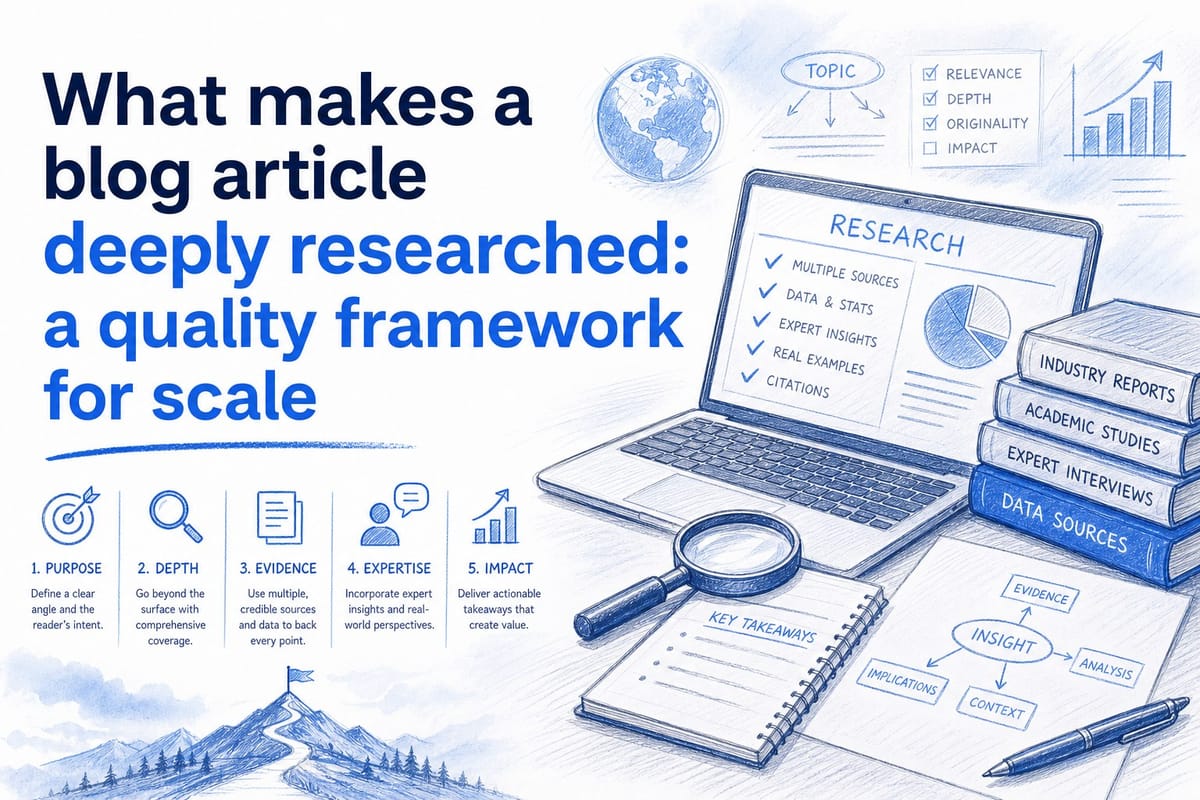
Table of contents
1. What deeply researched actually means (and what it does not)
2. Building a quality framework you can apply at scale
3. How to maintain research quality when you are publishing at scale
Most blog articles online are thin. They repeat the same surface-level points, pull from the same top-ranking pages, and add nothing new to the conversation. Readers notice, and so does Google. If you want your content to actually rank and build trust with an audience, you need a clear standard for what "deeply researched" really means in practice. That standard is what I call a deeply researched blog article quality framework, and it is the difference between content that compounds in value over time and content that gets ignored the week it is published. In this article, I break down exactly what goes into a high-quality, deeply researched article, how to apply that standard consistently, and how growing brands can scale that standard without burning out a team.
What deeply researched actually means (and what it does not)
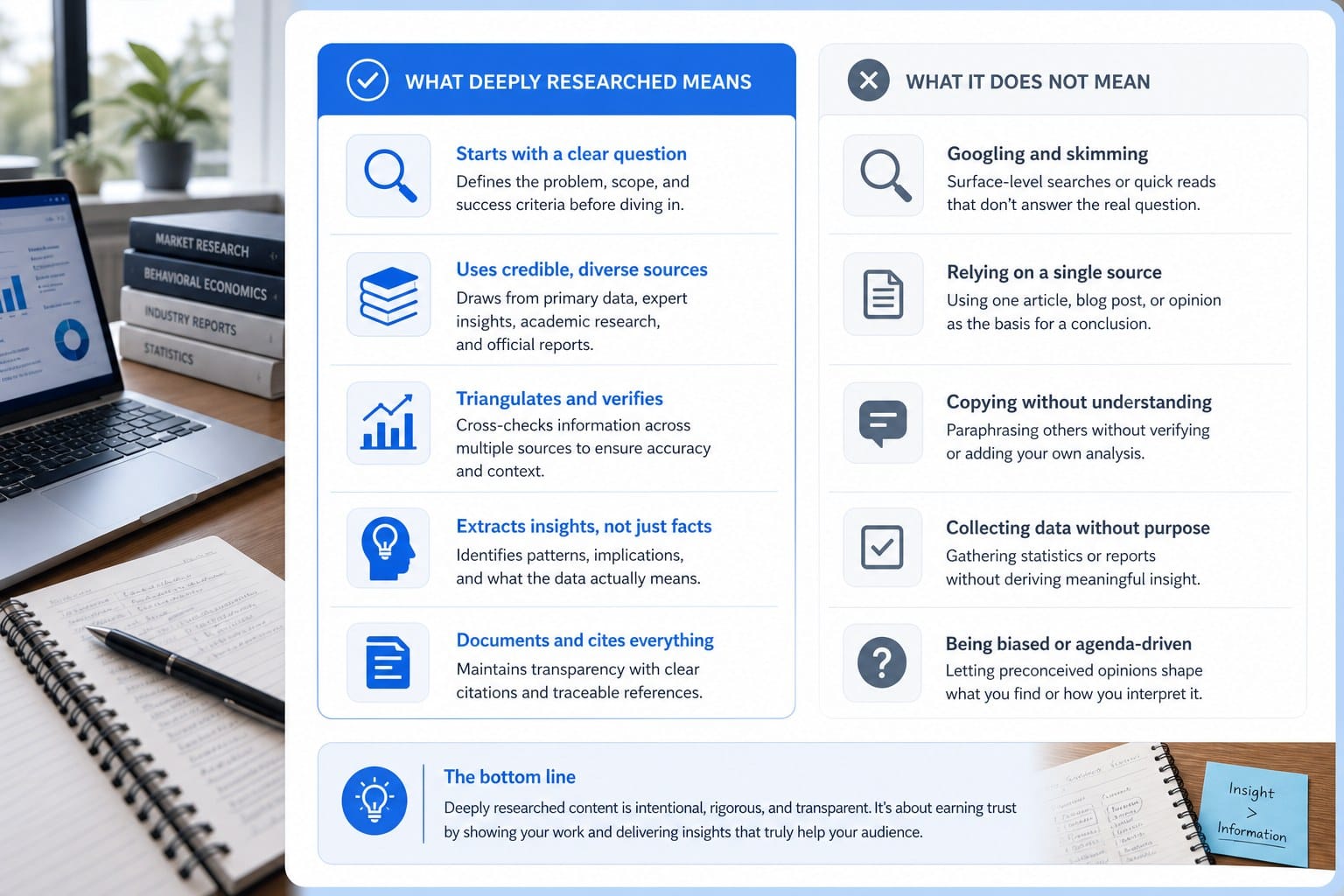
The phrase "deeply researched" gets thrown around a lot in content marketing circles, but very few people define it in a way that is actually useful. So let me be direct about what it means and what it does not mean.
Deeply researched does not mean long. An article can be 4,000 words and still be shallow. It does not mean citing a lot of sources either. You can stack ten links into a paragraph and still say nothing original. And it definitely does not mean repeating what the top-ranking articles already say in slightly different words.
Deeply researched means the article answers the real question behind the search query, not just the surface question. It means the writer understood the topic well enough to explain it clearly, add context that is genuinely useful, and connect ideas in a way the reader would not find by scanning five other articles on the same topic.
Let me give you a concrete example. Say someone searches for "how to reduce churn for a SaaS product." A shallow article lists five generic tips: improve onboarding, send emails, offer discounts, gather feedback, build community. Every article on page one of Google probably has some version of that list.
A deeply researched article does something different. It explains why each of those tips works or fails depending on your product stage, customer segment, and pricing model. It pulls from real patterns in SaaS growth data. It distinguishes between voluntary and involuntary churn and explains why confusing the two leads to bad decisions. It gives the reader a mental model they can actually use, not just a checklist.
That is the standard. And it requires a specific set of inputs to produce consistently.
Here is what I think of as the core ingredients of a deeply researched article:
Primary source understanding. The writer or content system must engage with original material: studies, product documentation, expert interviews, industry reports, or first-person experience. Not just summaries of summaries.
Audience-specific context. Deep research means understanding who is reading and what they already know. An article written for a SaaS founder should not explain what churn is. It should start from a place of assumed competence and go somewhere useful from there.
Accurate keyword alignment. The article should be built around what the target reader is actually searching for, not just what sounds related. This is why keyword research matters so much at the planning stage. If you pick the wrong keyword, you can write the most thorough article in the world and still attract the wrong readers or no readers at all. Good keyword alignment starts well before you write a single word, and it connects directly to your broader content strategy.
Structural logic. A deeply researched article is organized around the reader's journey through the topic, not around what is easy to write. Each section should build on the last. Transitions should make sense. The reader should feel like they are being guided, not just presented with information blocks.
Original synthesis. This is the hardest part and the most important. Original synthesis means you are connecting dots in a way that is specific to this article, this audience, and this moment. It might be a comparison no one else has made. It might be a framework you have developed from observing patterns. It might be a counterintuitive argument backed by evidence. Whatever form it takes, the reader should finish the article thinking something they did not think before.
None of these ingredients are optional if you actually want the article to perform. And none of them happen by accident. They require a deliberate process, which brings me to the next section.
Building a quality framework you can apply at scale
Knowing what deep research looks like is useful. Having a repeatable framework for producing it is what actually moves the needle for a growing brand.
The problem most content teams run into is that quality degrades as volume increases. The first few articles are well-researched and thoughtful. Then the calendar starts filling up, deadlines get tight, and the team starts cutting corners. The research phase shrinks. The editing pass gets skipped. The result is a blog that looks active but is not building any real authority.
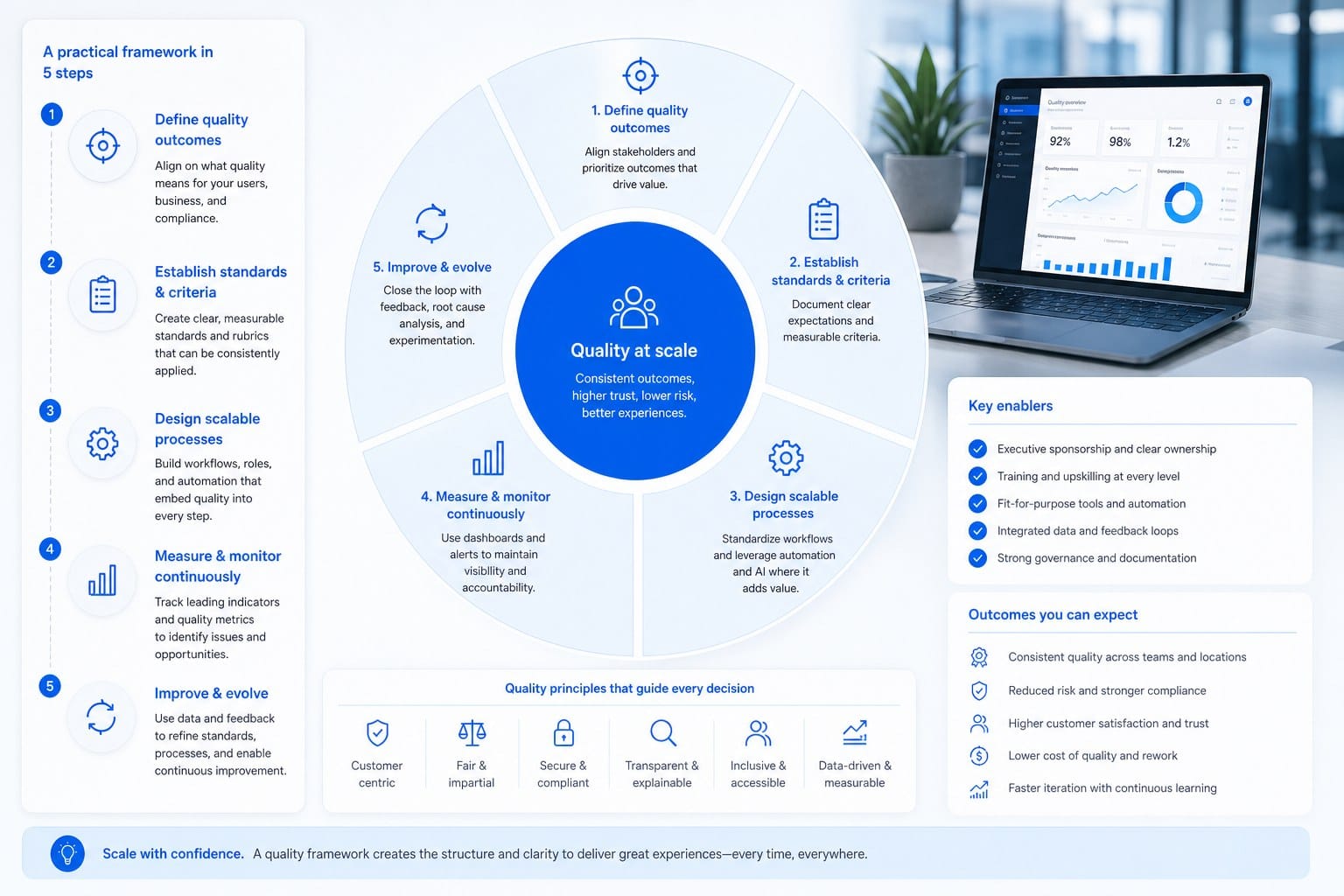
A quality framework prevents that degradation. It sets a minimum standard for every article that gets published, regardless of who writes it or how busy the schedule is. Here is how I think about building one.
Start with a content strategy that shapes research priorities.
You cannot deeply research everything. Trying to do so is how content teams burn out. A good content strategy identifies the specific topics, clusters, and keywords where your brand has the most credibility and the most opportunity to rank. Those become your research priorities.
For example, if you run a project management SaaS, you probably have more genuine expertise in topics like remote team coordination, sprint planning, and async communication than you do in general productivity advice. Your deeply researched articles should live in the territory where your expertise is real, because that is where your research will naturally go deeper than a generalist writer could.
This is also why AI-powered content strategy and editorial calendar planning is such an important step before you start producing content. The strategy shapes what you research, which shapes how deep you can go.
Define your research standard in writing.
This sounds obvious, but most brands never do it. A written research standard tells every person or system involved in content production exactly what "done" looks like at the research stage.
A solid research standard for a long-form article might include:
- At least two primary sources (industry reports, studies, expert quotes, or original data) per article - Evidence that the target keyword and related questions were validated before writing began - A documented understanding of the reader's knowledge level and what they already know - A clear articulation of the article's unique angle before the first draft starts
That last point is critical. If you cannot state what is unique about the article in one sentence before you write it, you are not ready to write it. The unique angle is what separates a deeply researched piece from a rewritten summary.
Build your keyword research into the process, not onto the end.
A common mistake is treating keyword research as something that happens after you decide what to write. The result is articles that are written around topics you find interesting rather than questions your audience is actually asking.
Keyword research should happen at the planning stage and should directly inform both the topic selection and the research direction. When you know that your target reader is searching for "how to reduce SaaS churn in the first 90 days," you know exactly what the article needs to answer and how specific your research needs to be. You also know what depth of answer is required to outperform what already exists on that topic.
If you want to understand how to integrate keyword research into your content planning process, how to do keyword research for a blog content calendar walks through the approach in practical detail.
Score articles before publishing.
A quality framework needs a checkpoint. Before any article publishes, it should pass a basic quality score that evaluates the research inputs, the structural logic, and the unique contribution. This does not have to be complex. Even a simple checklist with five or six criteria creates accountability and catches weak articles before they go live.
Here is an example of what that checklist might look like:
1. Does the article answer the full intent behind the target keyword, not just the surface question? 2. Is there at least one piece of original insight or synthesis that a reader would not find elsewhere? 3. Are claims supported by specific evidence rather than general assertions? 4. Is the structure built around the reader's journey through the topic? 5. Has the article been written at the right level of depth for the target audience's knowledge level? 6. Is the content factually accurate based on the primary sources consulted?
If an article fails two or more of these, it goes back for revision. If it passes, it is ready to publish. That simple gate keeps quality consistent even as volume scales.
Create topic briefs that carry research into the writing phase.
One of the biggest quality losses in content production happens at the handoff between research and writing. A researcher builds context and understanding, then passes a topic to a writer who may not have that context. The writer fills in gaps with generic content, and the deep research gets lost.
A detailed topic brief solves this. The brief should carry forward the unique angle, the key research inputs, the intended reader, the target keyword, the structural outline, and any specific claims that need to be made. When the writer has that foundation, the article starts from a place of depth rather than having to build it from scratch.
This is also the layer where AI-powered content systems can add significant value. When the brief is well-constructed, an AI system can produce a first draft that already contains the research foundation. The human review then focuses on accuracy, tone, and the quality of the synthesis rather than starting from zero.
Maintain a living content quality log.
A quality framework is not static. The best content teams track which articles perform well and which fall short, and they use that data to refine the framework over time. A living quality log connects article performance data to the research and structure decisions made at the planning stage.
Over time, patterns emerge. Maybe articles with original data consistently outperform those without it. Maybe a specific article format drives more time on page. Maybe certain topic clusters produce backlinks and others do not. Those patterns inform future research priorities and quality standards, creating a feedback loop that makes the framework smarter with every publishing cycle.
How to maintain research quality when you are publishing at scale
Here is the tension at the heart of content marketing: the brands that publish consistently are the ones that build compounding organic traffic over time. But maintaining deep research quality while publishing at scale is genuinely hard without the right systems in place.
I want to be honest about this because a lot of content advice glosses over the difficulty. Publishing one deeply researched article a month is manageable for most teams. Publishing two or three a week at the same standard is a completely different challenge. It requires infrastructure, not just effort.
Let me walk through how brands that get this right actually do it.
They invest in the planning stage more than the writing stage.
Brands that consistently publish high-quality content at scale spend more time and resources on planning than most people expect. They build out detailed content calendars weeks or months in advance. They validate topics and keywords before anyone starts writing. They develop briefs before they assign articles.
This front-loading feels slower at first. But it dramatically speeds up the writing and review stages because every article starts from a clear, well-researched foundation. The writer is not figuring out the angle while writing. The editor is not discovering gaps in the research during review. The process moves faster because the hard thinking happened before the typing started.
This is also why consistency compounds so well over time. When your planning is strong, your research inputs are strong, and your publishing cadence becomes predictable. Predictable publishing is what builds a readership and an SEO footprint. The research behind why consistent blog publishing delivers the highest ROI for growing brands makes this case in detail, and it is worth reading if you are still weighing whether to invest in a consistent content schedule.
They separate research roles from writing roles.
In small teams and solo operations, one person often tries to do everything: strategy, research, writing, editing, and publishing. This works for a while, but it breaks down quickly as volume increases. The research phase is the first casualty because it is the hardest and least visible part of the process.
The brands that scale quality successfully separate these roles, even if the "role" is just a different phase of one person's day. Research happens at a different time and with a different mindset than writing. When you sit down to write, the research should already be done. You should be translating understanding into clear prose, not figuring out what you think while you type.
This separation is also what makes AI-powered content systems genuinely useful for maintaining quality at scale. A well-designed system can handle the research aggregation, brief creation, and first-draft production, freeing the human contributor to focus on the synthesis, accuracy review, and the unique insights that require real expertise. That division of labor is what allows a small team or a solo creator to publish at a volume and quality that would otherwise require a full editorial staff.
They audit existing content regularly.
Deep research quality is not just about new articles. It is also about maintaining the accuracy and depth of articles already published. Information changes. Studies get updated. Products evolve. An article that was deeply researched two years ago may now contain outdated claims or miss important context.
Brands that maintain quality at scale build content audits into their process. They review top-performing articles on a regular cycle, update research where needed, and improve sections that have become shallow relative to what is now known about the topic. This practice also provides SEO benefits, since updated content often sees improved rankings, but the primary reason to do it is quality. An outdated article misleads readers, which erodes trust faster than publishing nothing at all.
They measure quality outputs, not just publishing volume.
A common mistake in content operations is measuring success by the number of articles published. Volume is easy to measure and feels like progress, but it can mask quality problems. A brand that publishes 20 shallow articles a month may be outperformed by a competitor publishing eight deeply researched ones.
The metrics that actually reflect quality are the ones tied to reader behavior and search performance. Time on page tells you whether readers are engaging with the content or bouncing after a few seconds. Scroll depth tells you whether they are reading to the end. Backlinks tell you whether other sites found the content valuable enough to reference. Rankings tell you whether the research depth is sufficient to compete on the target keyword.
When these metrics decline, it is usually a research quality problem. Either the article did not answer the full intent behind the keyword, or the depth was insufficient to differentiate from what already exists, or the synthesis was not original enough to give readers a reason to stay and share.
Building these quality metrics into your content reporting keeps the framework honest. It connects the inputs (research standard, brief quality, keyword alignment) to the outputs (rankings, engagement, backlinks) so you can see exactly where the process needs improvement.
They use automation for the repeatable work, not for the judgment calls.
This is probably the most important principle for scaling quality without sacrificing it. There are parts of the content process that are genuinely repeatable and can be handled by systems: topic generation based on keyword data, brief creation from a defined template, scheduling and publishing to a CMS, formatting consistency. Automating these tasks frees up human time and attention for the work that requires judgment.
The judgment calls in content production are the ones that determine quality: Is this angle original enough? Is this claim supported by solid evidence? Is this explanation clear to someone at this knowledge level? Does this article add something that the reader genuinely needs? Those questions cannot be fully automated, but they can be answered more efficiently when the repeatable work is handled by a system.
This is exactly the model that Blogtude is built around. The platform handles the strategy, research aggregation, content production, and publishing workflow, so the human contributor can focus on the decisions that actually require expertise. The result is a deeply researched blog article quality framework that scales without requiring a full editorial team to maintain it.
For independent bloggers, SaaS founders, small business owners, and digital marketers who need consistent content output without the overhead of a content team, that kind of infrastructure is what makes scaling quality actually achievable rather than just theoretically possible.
The brands winning in organic search right now are not necessarily the ones with the biggest teams or the biggest budgets. They are the ones with the clearest quality standards and the best systems for maintaining those standards at scale. A well-defined, consistently applied deeply researched blog article quality framework is what separates them from the brands still publishing thin content and wondering why it is not working.

Ready to take the next step?
If you want to publish deeply researched content consistently without building a full editorial team, Blogtude does the heavy lifting for you. The platform generates your 30-day content strategy, produces long-form articles built on real research, and publishes directly to Ghost and other CMS platforms automatically. Visit https://blogtude.com to see how it works and start building a content system that actually scales.