
How to scale blog content without hiring writers


Table of contents
1. Why most content scaling attempts fail before they start
2. The practical workflow for high-volume content without a writing team
3. Making sure your scaled content actually performs
Most growing brands hit the same wall. You know you need consistent blog content to build organic traffic, but hiring a full writing team is expensive and slow. A single experienced content writer can cost anywhere from $50,000 to $80,000 a year as a full-time hire, and freelancers who produce quality long-form work are rarely cheap or always available. So the question becomes: how do you scale blog content without hiring writers and still publish articles that actually rank and build trust with your audience? The answer is not to write less. It is to change how content gets made. In this article, I will walk through the real mechanics of scaling blog output without adding headcount, including the systems, tools, and workflows that make it sustainable for solo founders, small business owners, and lean marketing teams.
Why most content scaling attempts fail before they start
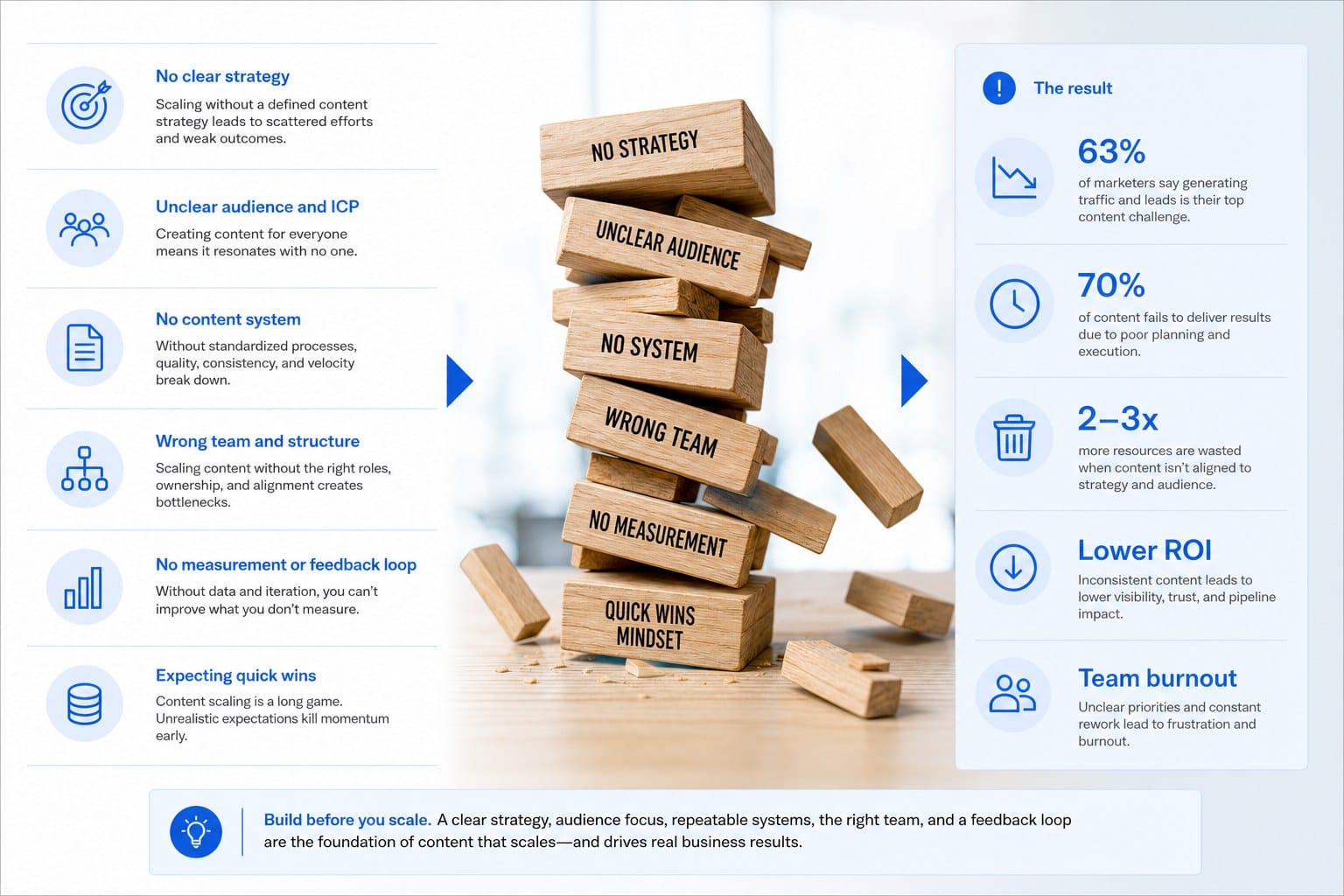
Before getting into solutions, it helps to understand why most brands struggle to scale their blog in the first place. The problem is almost never laziness or lack of intent. It is that the traditional content workflow has too many manual steps, and each one is a potential bottleneck.
Think about what actually goes into publishing a single blog post. You need to identify a topic worth targeting, research the keyword landscape, outline the article, draft a thousand or more words, revise it, format it for your CMS, add visuals, write a meta description, and hit publish. On a good day, that takes a skilled writer three to five hours. If you want to publish twice a week, you are looking at six to ten hours of focused writing work every week, before you account for editing or uploading.
For a SaaS founder building a product at the same time, or a small business owner running operations, that is simply not available time. So the blog gets deprioritized. You publish once a month when you can, the content strategy has no real coherence, and the SEO results reflect that.
The other common failure mode is trying to do everything manually but at lower quality. Some businesses try to solve the time problem by writing shorter posts, publishing thin content, or recycling old material without adding real value. That approach tends to backfire because search engines reward depth and relevance, not volume for its own sake. Publishing twenty shallow posts does less for your organic traffic than publishing eight genuinely useful, well-researched articles.
The scaling problem, then, has two sides. You need more content, and you need it to be good. Solving only one of those is not enough.
The brands that successfully scale blog content without hiring writers are the ones that rethink the workflow entirely. They stop treating each article as a standalone project and start treating their blog as a system with predictable inputs and outputs. That shift in thinking is what makes everything else possible.
A good content system starts with strategy. Most teams that are behind on publishing are behind because they do not have a clear list of topics to work from. Every time they sit down to write, they spend the first hour just figuring out what to write about. That is a productivity killer. When you have a 30-day or 90-day content calendar built around real keyword opportunities and audience intent, the decision-making overhead disappears. You know exactly what comes next, and the only job left is execution.
For independent bloggers and content creators, this kind of structure is what separates people who publish consistently from people who publish when they feel inspired. Inspiration is unpredictable. Systems are not.
If you want to dig deeper into how organic traffic actually builds through blogging, How SaaS startups can use blogging to drive organic traffic from day one is worth reading. The principles there apply to any brand building long-term search presence, not just SaaS companies.
The practical workflow for high-volume content without a writing team
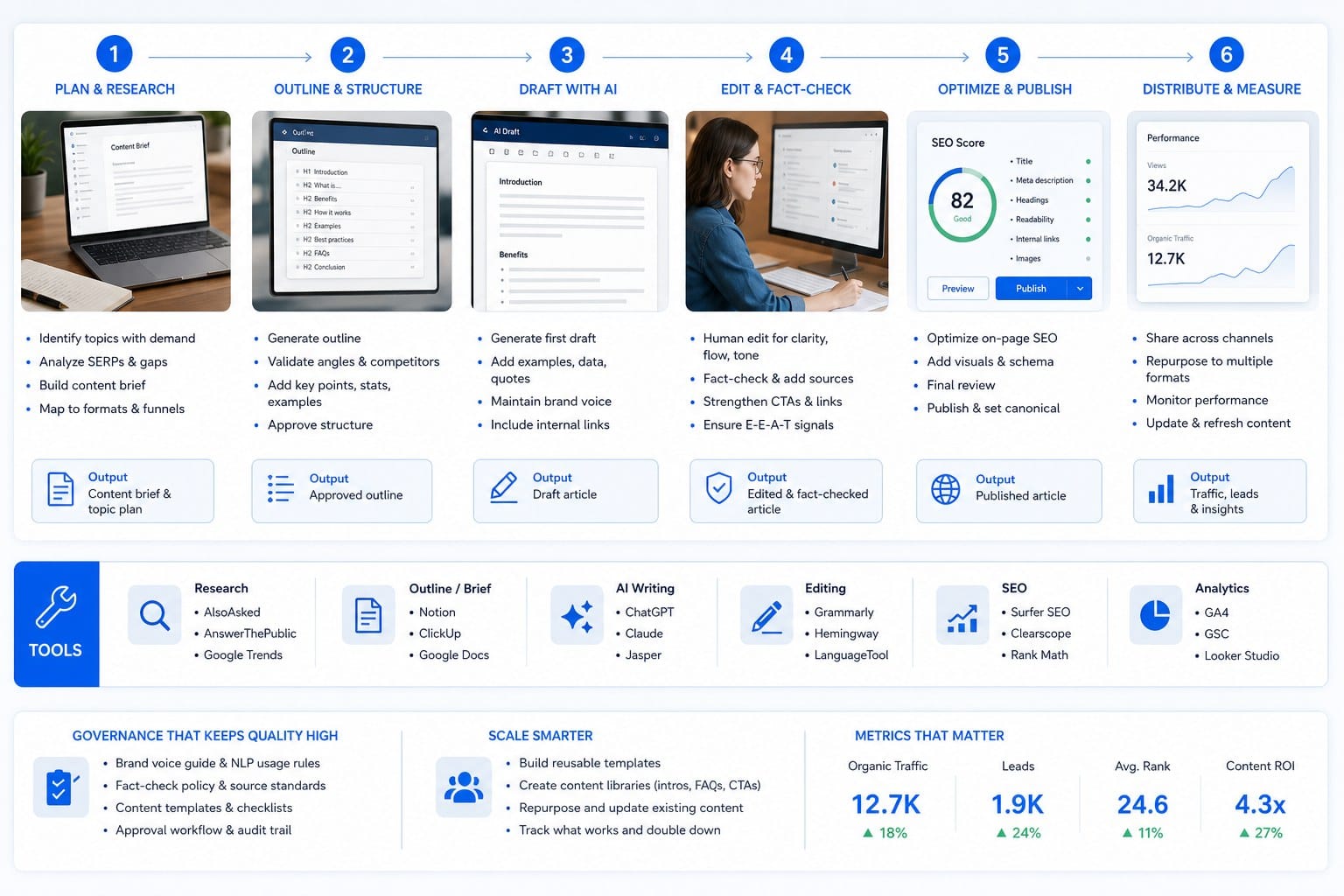
Once you understand why manual workflows break down under pressure, you can start building something better. The goal is a content operation where the strategy, research, writing, and publishing steps are handled as automatically as possible, with your time focused on review and direction rather than execution.
Here is how that workflow looks in practice.
Step one is topic and keyword research at scale. Instead of picking one topic at a time and doing research for each piece individually, you want to generate a full content calendar in one session. This means identifying your core topic clusters, finding the specific keywords and questions your audience is searching, and mapping those to a publishing schedule. When this step is done well, you end up with thirty or more article ideas that are all relevant, all tied to search intent, and all logically connected to each other. That interconnection matters because internal linking between related articles is one of the most underrated ways to improve how search engines crawl and rank your site.
For digital marketers managing brand blogs, this kind of structured topic planning also makes it much easier to report to stakeholders. Instead of saying you published four posts this month, you can show that you published four posts that target specific keywords in a deliberate cluster strategy. That is a very different conversation.
Step two is content production. This is where AI writing tools have genuinely changed the math for small teams. Modern AI content engines can produce long-form drafts that go well beyond surface-level summaries. The better tools pull in real research, structure arguments logically, and write at the depth that both readers and search engines expect from a quality post. This is different from earlier generations of AI writing software that produced thin, repetitive content that needed to be almost entirely rewritten to be usable.
The key distinction to understand here is between AI-generated content that is a starting point and AI-generated content that is production-ready. For most businesses trying to scale blog content without hiring writers, you want the latter. You want drafts that are good enough to publish after a focused review pass, not drafts that require the same amount of effort as writing from scratch. If you spend three hours editing an AI draft, you have not saved meaningful time compared to writing the article yourself.
This is why the quality of the underlying content engine matters so much. A tool built specifically for long-form blog content, with deep research built in, will produce very different output than a general-purpose AI assistant asked to write a blog post.
Step three is visuals. This is one of the most overlooked parts of blog production, and it is a place where a lot of small teams lose significant time. Finding or creating featured images and in-article visuals for every post takes time, requires design skill or a stock image subscription, and is genuinely tedious. Platforms that generate on-brand visuals automatically as part of the content workflow remove that friction entirely. Your posts look polished and consistent without any design work on your end.
Step four is publishing. If you are manually copying and pasting content into your CMS, formatting headers, adding tags, setting metadata, and scheduling posts one at a time, you are adding significant overhead to every single article. For Ghost CMS users especially, the ability to have content automatically published directly to your site is a major unlock. It means the entire pipeline from topic idea to live post can happen without you touching the keyboard for each individual article.
I wrote more about how this kind of end-to-end publishing automation works in Automated blog publishing: the complete setup guide for growing brands. If you are using Ghost or planning to, that guide covers the specific setup steps in detail.
When all four of these steps are connected, the result is a content workflow that can produce several well-researched, properly formatted, published articles per week without requiring manual effort at each stage. For a solo operator or a two-person marketing team, that represents a genuine leap in output capacity.
Let me be specific about what this looks like in terms of numbers. Say you want to publish three articles per week. Under a traditional workflow with a freelance writer, you might pay $150 to $400 per article depending on the writer and the length, plus your own time managing briefs, reviews, and edits. That is $450 to $1,200 per week in direct costs, plus several hours of your time. Over a year, that adds up to $23,000 to $62,000 in writing costs alone, and that assumes the freelancers are always available and always deliver on time.
An AI-powered content system producing the same volume costs a fraction of that, runs without scheduling delays, and does not require you to manage people. For small business owners who are watching every dollar, that difference is not marginal. It is the difference between having a real content operation and not having one.
There are real tradeoffs to acknowledge here too. AI-generated content, even high-quality output, benefits from human review. Your unique expertise, brand voice, and specific customer insights are things that you bring to the content that no tool can fully replicate. The most effective approach treats automation as handling the heavy lifting of research, structure, and drafting, while you add the perspective and judgment that comes from actually running your business. That combination tends to produce content that is both efficient to create and genuinely useful to readers.
For content creators who have built an audience around their personal voice, this balance is particularly important. You might use automated tools to handle research-heavy posts and evergreen reference articles, while reserving your personal writing time for opinion pieces, personal essays, and content where your individual perspective is the main draw. That kind of intentional split lets you scale volume without homogenizing everything you publish.
Making sure your scaled content actually performs
Producing a lot of content efficiently is only valuable if that content does something useful for your business. The whole point of scaling blog output is to grow organic traffic, build authority in your niche, generate leads, or some combination of all three. So the last piece of the puzzle is making sure the content you are producing is set up to perform.
This comes down to a few concrete practices that do not require a large team to implement but do require consistent attention.
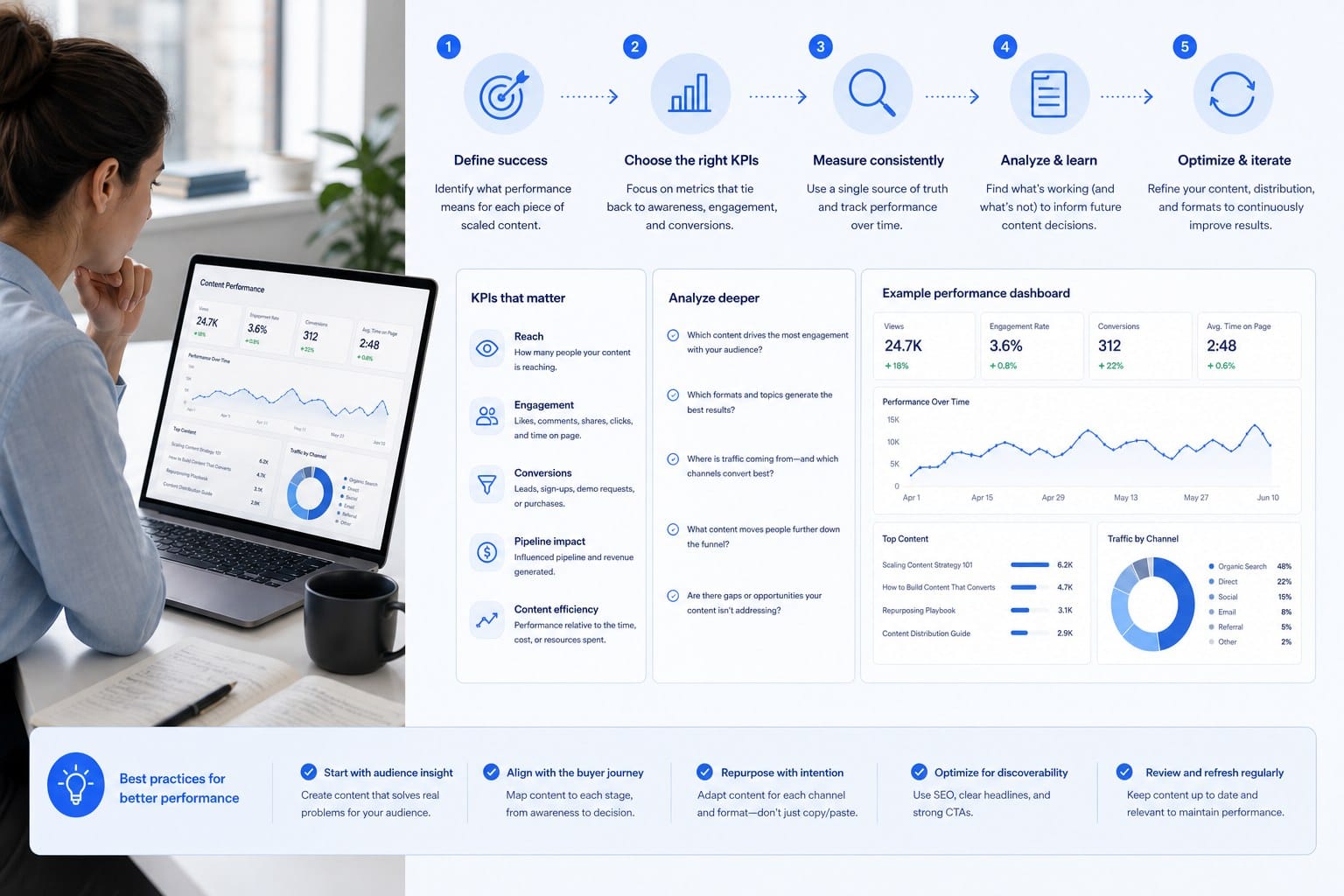
First, every article needs to target a specific, realistic keyword. Not all keywords are worth chasing. A brand-new blog going after a keyword with enormous competition and high domain authority in the top results is unlikely to rank, no matter how good the article is. A useful starting point is finding keywords with genuine search volume where the existing results are not uniformly from major publications or high-authority domains. Those are the gaps where newer sites can actually compete.
For most small business owners and indie bloggers, this means going narrower than you might initially think. Instead of trying to rank for a broad term with millions of searches per month, you target a longer, more specific phrase that has a few hundred or a few thousand searches per month and much lower competition. Rank for enough of those, and the aggregate traffic adds up quickly. More importantly, visitors coming in through specific long-tail queries tend to be further along in the research process, which means they are often better-qualified leads.
Second, your articles need to cover their topic with real depth. I mentioned this earlier but it bears repeating because it is where a lot of AI-generated content falls short. A post that gives a surface-level overview of a topic that readers can get anywhere does not earn links, does not hold attention, and does not build trust. A post that goes three layers deep, answers the obvious question and then addresses the follow-up questions a thoughtful reader would have, explains context and trade-offs, and gives concrete examples does all of those things.
Deep coverage is also what earns you featured snippets and other enhanced search results. When your article is the most thorough answer to a question, search engines notice.
Third, your content needs an internal linking structure. This is something that is easy to overlook when you are publishing at scale, but it pays significant dividends over time. Each new article should link to at least two or three other relevant articles on your site, and your older articles should be updated periodically to link to newer content. This creates a web of connections that makes your entire site easier for search engines to crawl and signals that your content is organized around real topic authority rather than isolated posts.
For Ghost CMS users, internal linking is something you can build into your content workflow by default, rather than treating it as an afterthought. When your content engine knows your existing published articles, it can suggest or automatically include relevant internal links in each new piece.
Fourth, track what is working and adjust. I see a lot of small teams publishing consistently but never looking at what their content is actually doing. After a few months of regular publishing, your analytics will start to show you which topics are drawing the most traffic, which articles people are spending the most time on, and which ones are generating leads or email signups. That data should directly inform your next content calendar. Double down on what is working. Learn from what is not.
This is one area where the advantage of having a structured content strategy really shows. When all your articles are mapped to specific keywords and goals, it is straightforward to measure performance by topic cluster and make informed decisions about where to focus next. When you are just publishing whatever felt interesting at the time, the data is much harder to act on.
Fifth, do not neglect older content. For most blogs, a significant percentage of organic traffic comes from articles that were published months or years ago. Those older posts often have some authority built up from age and any links they have earned, but the information in them may be outdated, or the article may not be as thorough as it could be now. Updating and expanding those posts is often faster than writing new ones from scratch, and it can produce meaningful traffic lifts relatively quickly.
If you are using an automated content workflow, you can schedule periodic content audits just as you would schedule new articles. Pick a set of your most-visited or highest-potential older posts each quarter and run them through a refresh process where you update statistics, add new sections, improve the internal linking, and republish with a new date.
All of these practices compound over time. A blog that publishes three well-researched, properly targeted articles per week and maintains its older content will look very different at the eighteen-month mark than one that publishes sporadically with no strategy. The compounding nature of SEO is what makes getting a system in place early so valuable. Every article you publish and every link you build makes the next piece of content slightly easier to rank.
For anyone wondering whether an AI content engine is actually the right fit for their specific situation, What is an AI content engine and does your brand need one lays out the honest case for when it makes sense and when it might not. It is worth a read before committing to any particular approach.
The bottom line is that scaling blog content without hiring writers is not about cutting corners. It is about building a smarter workflow that handles the repetitive, time-consuming parts of content production automatically, so that your limited time goes toward the decisions and judgment calls that actually require a human. When you get that balance right, you can publish at a volume and quality that would have required a full content team just a few years ago, without the overhead, the management complexity, or the budget.
Ready to take the next step?
Blogtude is built to make this kind of scaled content operation a reality for brands that do not have a writing team. It generates a full 30-day content strategy, produces deeply researched long-form articles with on-brand visuals, and publishes directly to Ghost and other CMS platforms automatically. If you are ready to stop falling behind on your blog and start building a real content engine, visit blogtude.com to see how it works.