SEO content strategy for independent bloggers: a step-by-step playbook

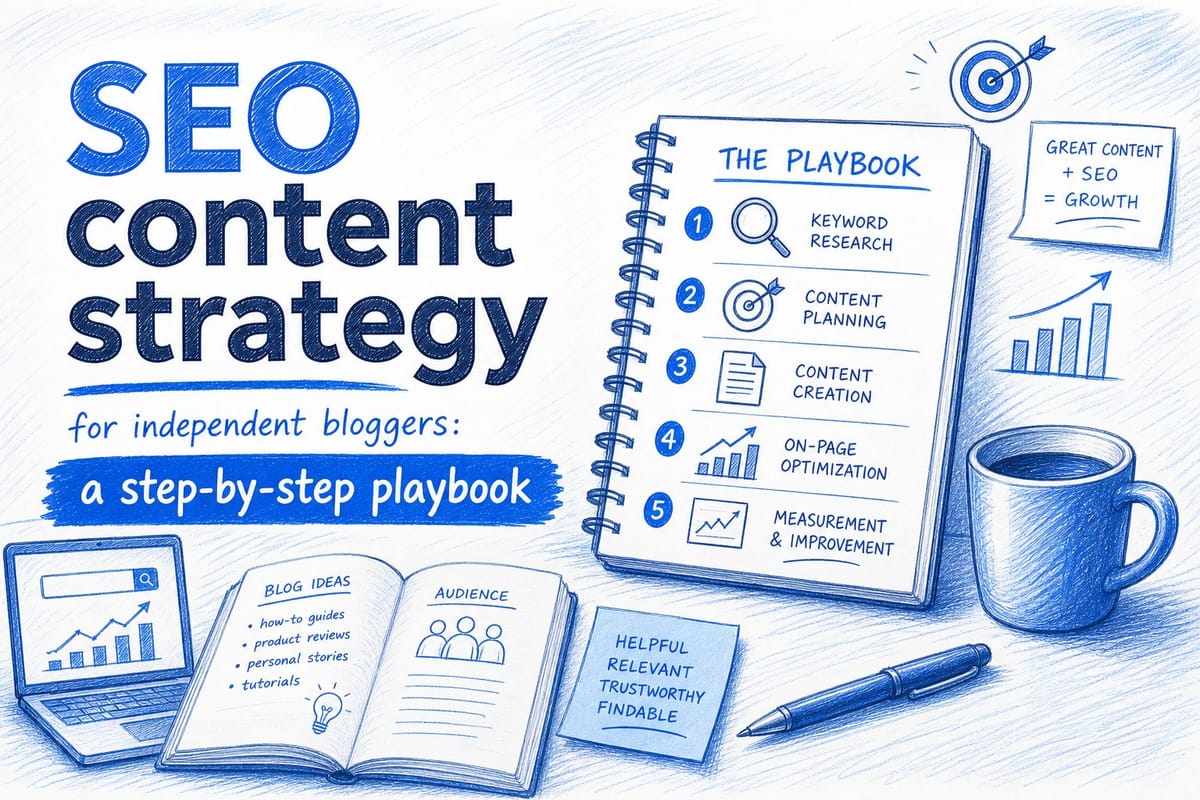
Table of contents
1. Step 1: Build a keyword and topic foundation that actually matches what people search
2. Step 2: Write posts that satisfy both readers and search engines
3. Step 3: Build consistency into your workflow so the strategy actually runs
If you run a blog on your own, you already know the frustration. You write a post, hit publish, and then wait. Traffic trickles in slowly, or sometimes not at all. You check your analytics, wonder what went wrong, and start the whole cycle over again. The problem usually is not the writing itself. It is the lack of a clear SEO content strategy for bloggers that connects every post to a bigger goal. A strategy turns random publishing into a system that builds on itself over time. In this playbook, I will walk you through how to build that system step by step, from picking the right topics to publishing consistently without burning out.
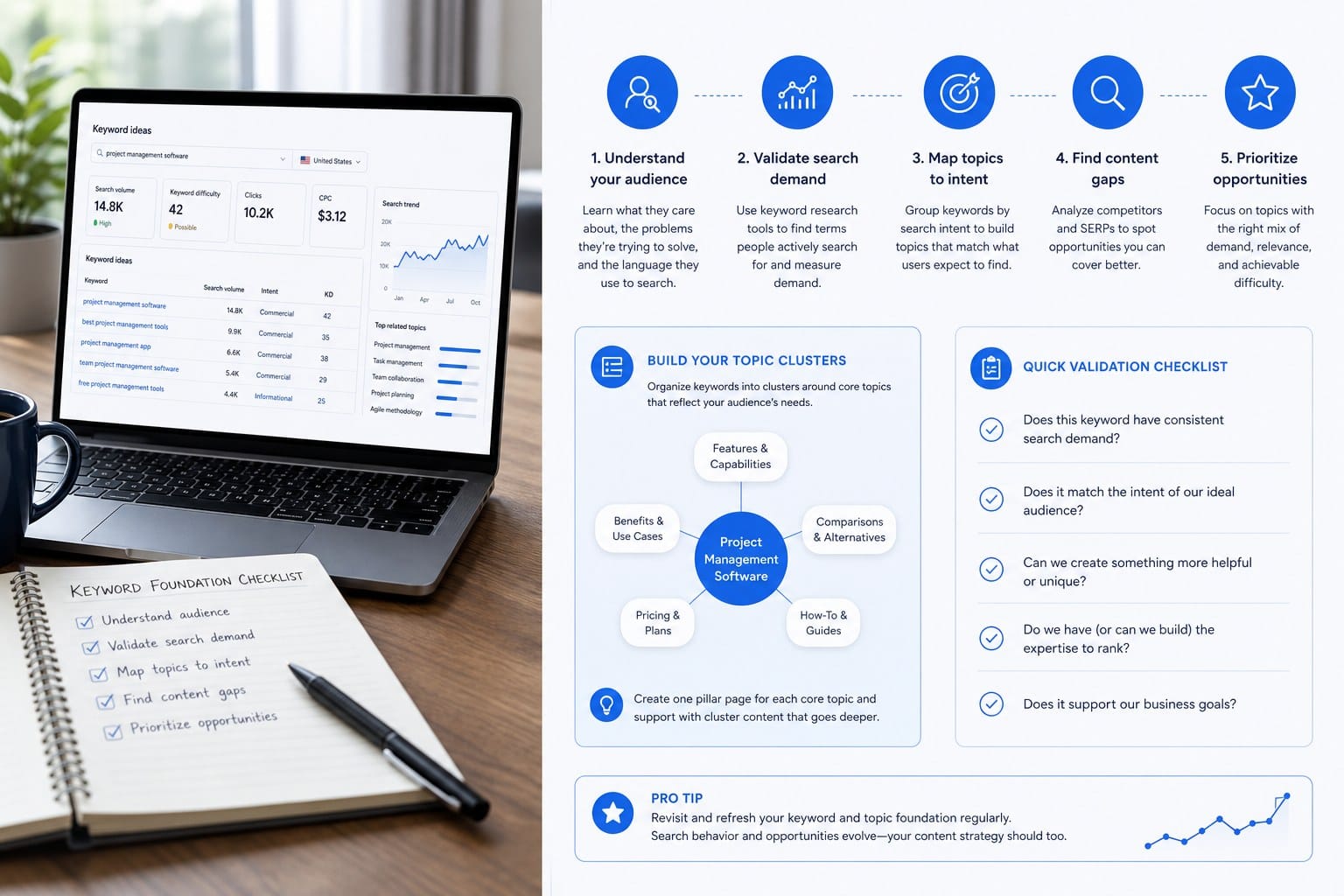
Step 1: Build a keyword and topic foundation that actually matches what people search
The biggest mistake independent bloggers make is writing about whatever feels interesting that week. That approach is fine for a personal journal, but it will not move the needle on organic traffic. A real SEO content strategy for bloggers starts with understanding what your audience types into Google and why.
Start with your niche, not broad topics. If you run a personal finance blog aimed at freelancers, you do not want to rank for "budgeting tips." That keyword is enormous and dominated by major media brands. You want to go narrower, something like "how to save for taxes as a freelance designer" or "quarterly tax estimates for self-employed writers." Those phrases have real search intent behind them, and the competition is far more manageable.
Keyword research does not have to be complicated. Use a free tool like Google Search Console if your site is already live. Type a seed topic into the search bar and look at the "People also ask" and "Related searches" sections at the bottom of the results page. Both of those are goldmines for finding the exact questions your readers are already asking.
Once you have a list of 20 to 30 potential topics, group them by intent. Search intent tells you what the searcher actually wants to accomplish. There are four main types. Informational intent means someone wants to learn something, for example "what is a SEP IRA." Navigational intent means they are looking for a specific site or brand. Commercial intent means they are comparing options, like "best budgeting apps for freelancers." Transactional intent means they are ready to buy or sign up. Most blog posts target informational and commercial intent, and that is where you should focus most of your energy.
After you group topics by intent, look at search volume and keyword difficulty together, never separately. A keyword with 10,000 monthly searches sounds exciting until you realize every result on the first page is a Forbes or NerdWallet article with thousands of backlinks. A keyword with 400 monthly searches and low competition is far more realistic for an independent blogger to rank for, and 400 readers a month from one article adds up fast when you have 30 or 40 articles working for you.
Next, build a content cluster model. A cluster is a group of related posts organized around one main topic, which is called a pillar page. The pillar page covers the broad subject in depth. The cluster posts dive into specific subtopics and link back to the pillar. For example, if your pillar page is "freelance finance guide," your cluster posts might be "how to invoice clients as a freelancer," "tracking business expenses without an accountant," and "best bank accounts for self-employed people." This structure signals to Google that your site has deep expertise on a subject, which helps every post in the cluster rank higher over time.
I find that bloggers who skip the cluster model end up with a site full of posts that compete with each other. Two posts targeting almost the same keyword split the traffic and confuse search engines about which page to rank. Building clusters from the start prevents that problem entirely.
One more thing to map out at this stage is your content calendar. Decide how many posts you can realistically publish per month and stick to that number. Consistency matters more than frequency. Publishing two solid posts every month for a year is far better than publishing ten posts in January and then going quiet until March. Search engines reward sites that show regular activity, and readers do too. If you want to understand why this compounds over time, the article on content compounding: why consistent blogging grows organic traffic exponentially explains the math behind it in a way that is genuinely motivating.
Step 2: Write posts that satisfy both readers and search engines
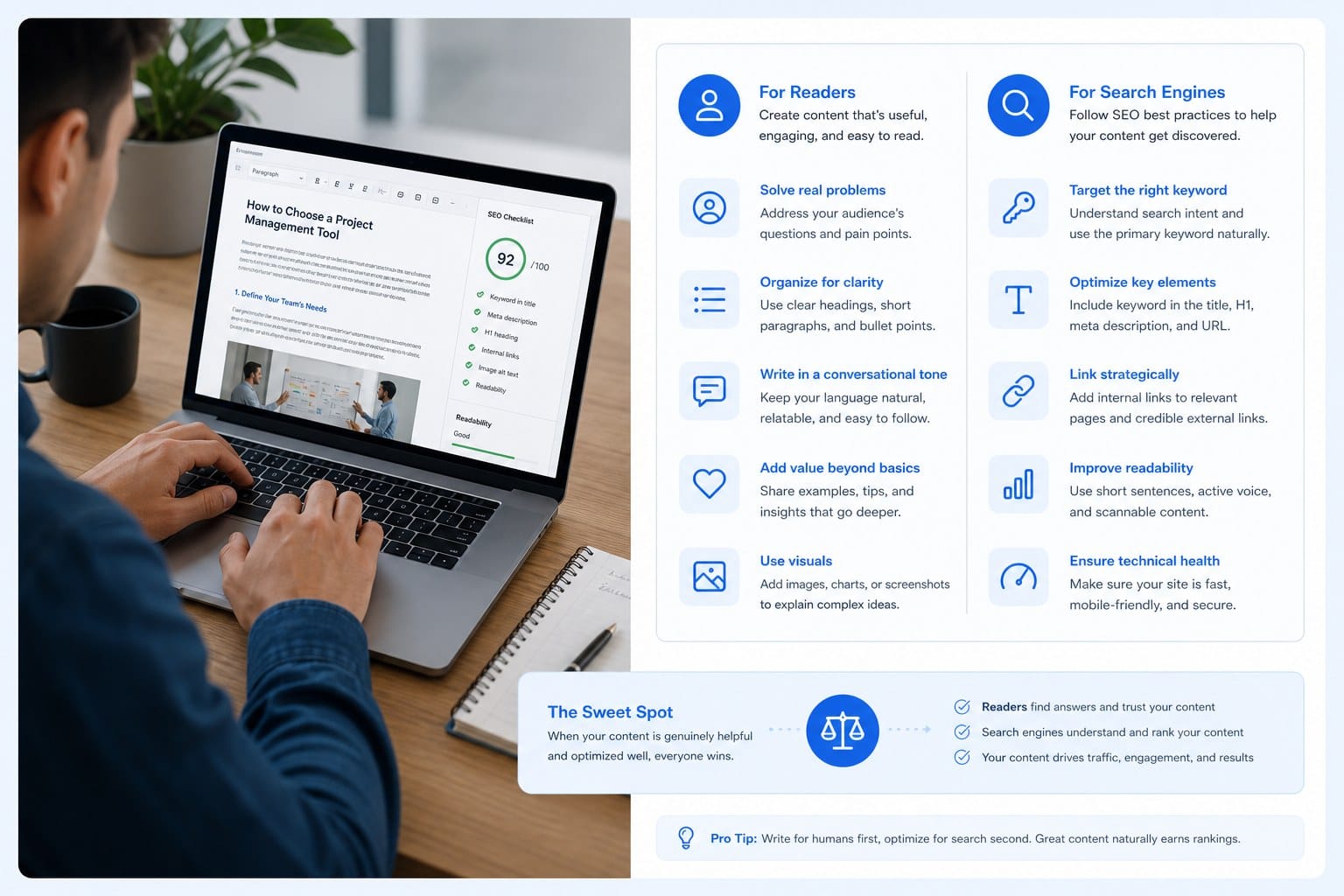
Once you have your topic list and calendar in place, the next step is creating content that actually earns rankings. A lot of SEO advice focuses purely on technical signals, word count, keyword density, heading structure. Those things matter, but they matter a lot less than whether your post genuinely answers the question a reader came to your site to solve. Google has gotten very good at telling the difference.
Start every post with a clear understanding of the primary keyword and the intent behind it. Before you write a single word, read the top five results for that keyword. Ask yourself what they cover well, what they miss, and where you can add something more useful, more specific, or more current. Your goal is not to copy what ranks. Your goal is to be more helpful than what ranks.
Here is a structure that works well for most informational blog posts. Open with a short, direct introduction that names the problem and promises a solution. Do not bury the lede with a long backstory. Get to the point within the first two or three sentences. Then use clear subheadings, formatted as H2 and H3 tags, to organize your main points. Each section should answer one specific question or cover one distinct idea. End with a conclusion that summarizes the key takeaways and gives readers a clear next step.
On-page SEO has a few non-negotiable elements. Your target keyword should appear in the title tag, the first paragraph, at least one H2 subheading, and naturally throughout the body of the post. Do not force it. If a sentence sounds awkward with the keyword in it, rewrite the sentence. Search engines understand synonyms and related phrases, so using natural language is always better than stuffing the same phrase in every other paragraph.
Meta descriptions are short summaries that appear under your page title in search results. Google does not always show them, but when it does, a well-written meta description can significantly improve your click-through rate. Keep yours under 160 characters, include your keyword, and make it feel like a genuine invitation to read the post, not a keyword list pretending to be a sentence.
Internal linking is one of the most underused on-page tactics I see independent bloggers ignore. Every time you publish a new post, link to two or three older posts that are related. And go back and update older posts with links to the new one. This creates a web of connections that keeps readers on your site longer and helps search engines crawl your content more efficiently. If you write a post about invoicing clients, link back to your pillar page on freelance finance. If you write about tax deductions, link to your post on expense tracking. These connections add up.
Content length is something bloggers overthink. The right length is however long the topic requires to be covered completely. Some queries are fully answered in 800 words. Others need 2,500 words. If you are explaining a complex process with multiple steps, go long. If you are answering a simple factual question, keep it tight. Padding a post with repetitive filler to hit an arbitrary word count actually hurts your rankings because it dilutes the quality of the content.
Visuals also play a bigger role in SEO than many bloggers realize. Images, charts, and custom graphics keep readers on the page longer, and time on page is a meaningful signal for search engines. More practically, original visuals get shared and linked to, which builds backlinks naturally. Every image you add should have a descriptive alt text that includes a relevant keyword phrase where it fits naturally. Alt text is not just an SEO trick. It is also how screen readers describe images to visually impaired users, so it serves a real accessibility purpose.
I also want to mention something that comes up often in the SEO content strategy for bloggers conversation: updating old content. Fresh posts get attention, but your existing posts are assets you have already invested in. If a post is sitting on page two or three of search results, a focused update can move it to page one. Update the statistics, expand thin sections, add new internal links, and refresh the publish date. This is one of the highest-return activities you can do as an independent blogger because the heavy lifting of building the page is already done.
For bloggers managing their sites on Ghost, the platform has several built-in SEO advantages around page speed and clean code that are worth understanding. If you are weighing platform options or want to see how Ghost stacks up for organic growth, the comparison of Ghost CMS vs WordPress for blogging: which platform wins for SEO covers the real differences in a practical way.
Step 3: Build consistency into your workflow so the strategy actually runs
Here is where most independent bloggers fall apart. They build a solid keyword list, write a few great posts, and then life happens. A client project runs long, a family obligation comes up, or they simply run out of creative energy. Publishing stops, momentum breaks, and the compounding growth they were starting to see levels off.
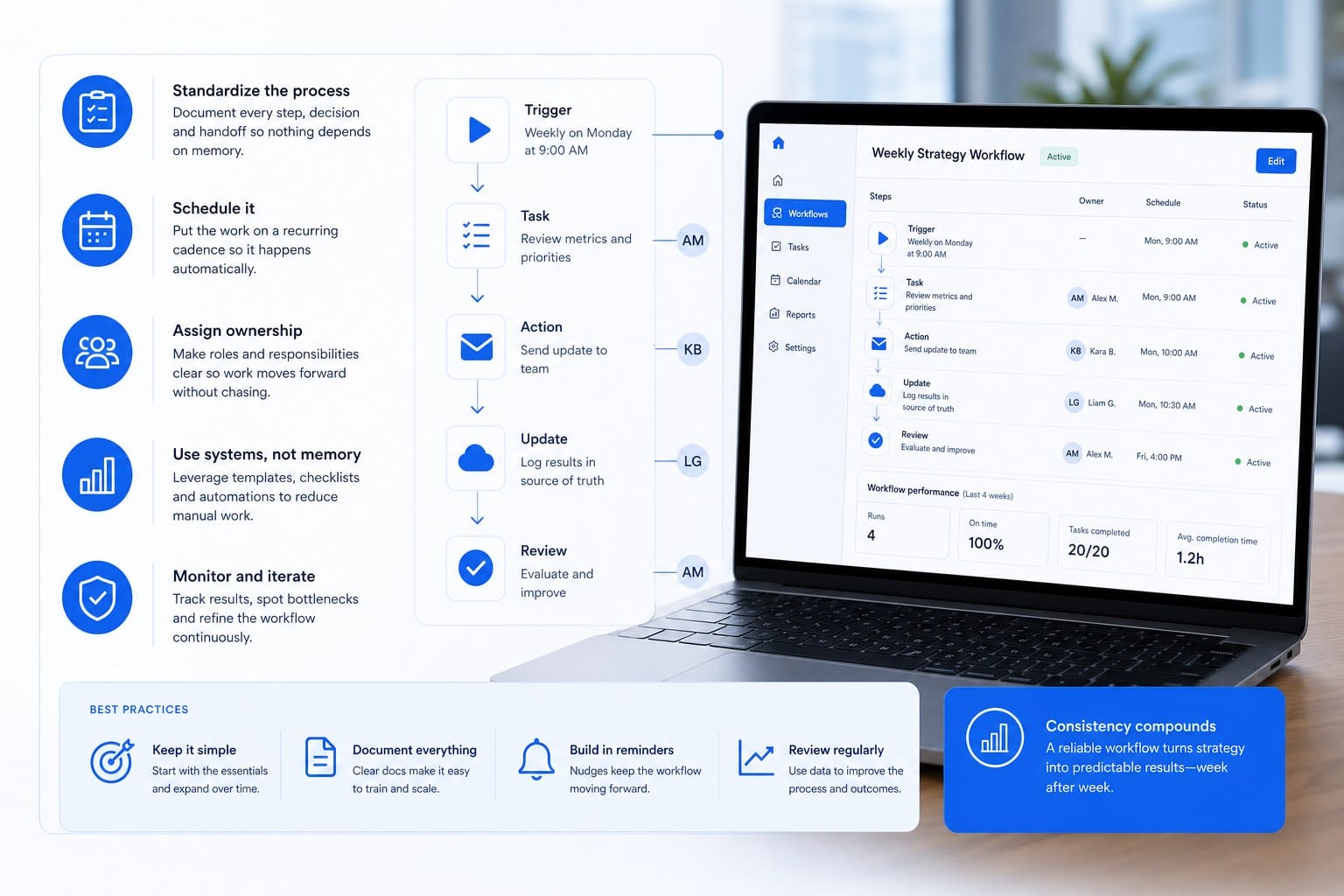
Consistency is not a motivation problem. It is a systems problem. The bloggers who publish reliably month after month are not more disciplined or more talented. They have built workflows that remove friction from the process so they can keep going even when things get busy.
The first step in building a reliable workflow is batching your work. Instead of coming up with a topic, doing research, writing, and publishing in one sitting every week, separate these tasks into dedicated sessions. Spend one afternoon per month doing all your keyword research and planning your upcoming topics. Spend another session doing the research and outlines for each post. Then write and edit in separate sessions. This batching approach is more efficient because your brain is not constantly switching between modes.
Templates are another tool that dramatically speeds up production. Create a standard structure for each type of post you publish. If you write how-to guides, have a template that starts with the problem, lists the steps with subheadings, and ends with a troubleshooting section and a call to action. If you write comparison posts, have a template with a comparison table and a recommendation section. Templates do not make posts feel formulaic. They just handle the organizational decisions so you can focus entirely on the writing and the information.
Repurposing content extends the life of every post you publish without requiring you to start from scratch. A long-form blog post can become a series of social media posts, a newsletter edition, a short video script, or an email sequence. You wrote the research and the ideas once. Repurposing just repackages them for different formats and audiences. For an independent blogger with limited time, this is one of the highest-leverage activities available.
Tracking your results is essential but it does not have to be complicated. Set up Google Search Console if you have not already. It is free, it shows you which queries are bringing people to your site, and it tells you your average position and click-through rate for each keyword. Check it once a week and look for two things: posts that are gaining traction that you can build on with cluster content, and posts that rank in positions four through fifteen that might move up with a targeted update.
A content audit is something I recommend doing every quarter. Go through your published posts and categorize them. Which posts are bringing in traffic and performing well? Keep those as they are or expand them. Which posts rank but have poor click-through rates? Those need better title tags and meta descriptions. Which posts get no traffic at all? Decide whether to update them, consolidate them with a related post, or remove them entirely if they add no value. A smaller site with consistent, high-quality content almost always outperforms a larger site with a mix of strong and weak content.
Building backlinks is the part of SEO that feels most out of your control as an independent blogger, but there are practical approaches that do not require a PR team. Write guest posts for other blogs in your niche and link back to your most relevant content. Create genuinely useful resources, like original data, a comprehensive guide, or a free tool, that other bloggers in your space will want to reference. Participate in online communities where your target readers hang out and share your content when it genuinely answers a question someone asked. These methods take time, but they build real authority in a way that artificial link schemes never do.
The question I hear most from independent bloggers is how to keep all of this running without it becoming a full-time job on top of an already full-time job. The honest answer is that a good SEO content strategy for bloggers does get easier over time as the system matures. But the early months are the hardest because you are building the infrastructure while also trying to produce content. Tools that automate parts of the workflow, particularly research, drafting, and publishing, can close that gap significantly. If you are curious about how automated workflows fit into a quality content strategy without replacing the creative judgment that makes a blog distinctive, the piece on how digital marketers can automate brand blog workflows without losing quality is worth reading.
Finally, think about the long game. SEO is not a sprint. Most new blog posts take three to six months to reach their peak rankings, and some take longer than that. The bloggers who succeed are the ones who keep publishing and improving during that waiting period instead of giving up because they do not see immediate results. Every post you publish is an asset. Every internal link you build strengthens the network. Every update you make to an old post refreshes its potential. The strategy I have outlined here is not a guarantee of overnight success. It is a system for building something durable that grows your traffic month after month, even when you are not actively thinking about it.
I built this playbook based on what actually works for independent bloggers who are managing everything themselves. Start with solid keyword and topic research organized into clusters. Write posts that genuinely serve the reader first and optimize for search engines second. Build a workflow that removes friction so you publish consistently even when your schedule is tight. Track your results, update your content regularly, and stay patient through the early months when the work feels invisible. That combination is what separates blogs that break through from blogs that stay stuck.
Ready to take the next step?
If you want to run this entire system without spending 20 hours a month on research, writing, and publishing, Blogtude can do the heavy lifting for you. Blogtude generates a full 30-day content strategy, produces deeply researched long-form articles with on-brand visuals, and publishes them automatically to Ghost and other CMS platforms. You get consistent, SEO-driven content without hiring a team or managing a complicated workflow. Visit blogtude.com to see how it works and start building a blog that grows on autopilot.